
-
Summary
For pharmaceutical and biotechnology sponsors, sustainable cost reduction in a Clinical Trial is rarely achieved by merely negotiating lower Contract Research Organization (CRO) unit rates. The most significant economic opportunities lie in eliminating avoidable protocol rework, improving site feasibility, accelerating regulatory start-up, focusing oversight on critical risks through risk-based monitoring, and structuring outsourcing models appropriately. Furthermore, aligning global execution with efficient regulatory frameworks—such as leveraging South Korea’s Ministry of Food and Drug Safety (MFDS) and its rapidly expanding biomanufacturing infrastructure—creates distinct timeline advantages. This report synthesizes current evidence from global regulatory guidelines, including ICH E6(R3), FDA, and EMA, alongside industry benchmarks to provide actionable strategies for reducing the total cost of ownership in Clinical Trials.
-
The Economic Imperative for Optimizing Clinical Trials
The global market for Clinical Trials is experiencing unprecedented expansion, valued at approximately $89.0 billion in 2025 and projected to reach $158.4 billion by 2033, representing a compound annual growth rate of 7.7%. Simultaneously, combined CRO and Contract Development and Manufacturing Organization (CDMO) R&D expenditures are structurally increasing, moving from $32 billion in 2014 to $82 billion in 2022, with estimates projecting $135 billion by 2029. Despite this massive capital deployment, operational efficiency within a Clinical Trial remains a critical bottleneck. Industry benchmark data reveals that the mean direct cost to implement a substantial protocol amendment in a Phase III Clinical Trial is $535,000, and a single day of delay in a late-stage Clinical Trial can cost sponsors upwards of $55,716.
The analytical consensus indicates that optimizing a Clinical Trial is fundamentally a quality-and-cycle-time challenge rather than a simple procurement exercise. Sponsors must manage Clinical Trial CROs as integrated performance systems. Outsourcing a Clinical Trial to a CRO transfers execution duties but does not alleviate the sponsor’s ultimate accountability for data integrity and participant safety. Therefore, modern Clinical Trials require prospective operational design to mitigate downstream financial risks and accelerate time-to-market.
-
Evidence-Based Strategies for Cost Reduction
1) Quality by Design and Mitigating Protocol Amendments
The foundational strategy for reducing Clinical Trial costs involves preempting downstream operational failures through Quality by Design (QbD). The regulatory transition toward ICH E6(R3) fundamentally restructures Good Clinical Practice (GCP) around critical-to-quality factors, requiring sponsors to proactively build quality into the protocol rather than relying on retroactive data correction.
Protocol complexity in Clinical Trials has reached historical highs. A standard Phase III Clinical Trial now collects an average of 5.9 million data points, representing an 11% annual increase since 2020, with up to 16.2% of procedures supporting non-core or exploratory endpoints. This complexity directly correlates with amendment frequency; current data indicates that 76% of Phase I-IV Clinical Trials require at least one substantial amendment, a sharp increase from 57% a decade prior. Because protocol amendments typically halt site activation in a Clinical Trial, force contract renegotiations, and require IRB resubmissions, they severely inflate the Clinical Trial budget. Nearly half of these amendments are deemed avoidable. Applying QbD principles allows a sponsor and their CRO to pressure-test eligibility criteria and visit burdens before the Clinical Trial commences, thereby preventing the cascading costs of mid-study modifications.
2) Risk-Based Monitoring (RBM) and Targeted Data Verification
Equating absolute quality with 100% Source Data Verification (SDV) is an outdated and financially inefficient paradigm for Clinical Trials. Regulatory agencies, including the FDA and EMA, explicitly support Risk-Based Monitoring (RBM) and proportional oversight frameworks. Implementing RBM allows a Clinical Trial CRO to define critical data variables, establish centralized monitoring triggers, and reduce unnecessary on-site visits.
Empirical evidence demonstrates that RBM maintains, and occasionally exceeds, the quality thresholds of conventional 100% SDV within a Clinical Trial. In a comprehensive peer-reviewed assessment covering over two million verified data points, RBM produced a 0.15% error rate in major efficacy data, compared to a 0.28% error rate with conventional monitoring methodologies. Furthermore, a well-executed RBM strategy in a Clinical Trial can reduce on-site monitoring time by up to 30%, converting fixed labor costs into variable, risk-adjusted expenditures. By focusing resources strictly on critical-to-quality data points, sponsors drastically reduce the data-cleaning burden without compromising the scientific integrity of their Clinical Trials.
3) Accelerating the Site Start-Up Lifecycle
The site start-up phase is the most persistent source of delayed timelines in global Clinical Trials. While the National Cancer Institute recommends a 90-day activation target, median activation times across academic medical centers often stretch to 9.4 months. Activating a single investigational site inherently costs approximately $25,000, and Clinical Trials that struggle to meet their 70% accrual thresholds experience significantly protracted median activation times compared to high-performing studies.
To compress this timeline, CRO partnerships must leverage data-driven feasibility analyses and parallel processing for IRB and budget negotiations. A high-performing Clinical Trial CRO bypasses underperforming sites early and relies on central regulatory review processes, which have been shown to reduce the time from protocol delivery to first enrollment from 287 days (local IRB) to 199 days (central IRB). Furthermore, integrating these workflows with advanced Clinical Trial Management Systems (CTMS) and Randomization and Trial Supply Management Systems (RTMS), such as those developed by SyMYOO, enables seamless data flow and enhanced visibility into site performance. Controlling the start-up phase prevents a Clinical Trial from burning administrative capital before the first patient is even screened.
4) Functional Service Provider (FSP) vs. Full-Service Outsourcing (FSO)
Optimizing Clinical Trial economics requires aligning the outsourcing model with the sponsor’s internal infrastructure. The industry has seen a strategic shift in how Clinical Trials are outsourced, increasingly favoring hybrid or Functional Service Provider (FSP) models for specific programmatic needs over rigid full-service agreements.
|
Outsourcing Model |
Clinical Trial Implementation Characteristics |
Financial & Operational Impact |
|
Full-Service Outsourcing (FSO) |
The CRO assumes end-to-end accountability for the Clinical Trial, providing integrated teams (clinical operations, data management, regulatory). |
High initial fixed costs; ideal for emerging biotechs lacking internal infrastructure. Carries a risk of change orders if Clinical Trial protocols shift. |
|
Functional Service Provider (FSP) |
The sponsor contracts specific functional units (e.g., biostatistics, monitoring) based on unit prices or Full-Time Equivalents (FTE). |
Can generate 15% to 30% cost savings compared to FSO. High flexibility but requires robust sponsor oversight and governance. |
|
Hybrid Arrangements |
Blends FSO for primary Clinical Trial operations with FSP resources for specialized, high-volume tasks. |
Optimizes resource allocation across global Clinical Trials; converts high fixed costs into manageable variable expenses. |
For large pharmaceutical companies executing a massive portfolio of Clinical Trials, FSP unit-based pricing removes redundant management layers and prevents CROs from applying generalized overhead to specialized tasks. Conversely, smaller biotechs benefit from FSO by gaining instant, scalable global capacity to run a Clinical Trial.
-
Regional Execution Strategies: South Korea’s Regulatory and Manufacturing Advantage
Country selection fundamentally dictates Clinical Trial costs, recruitment velocity, and downstream commercialization timelines. South Korea has emerged as a premier hub for global Clinical Trials, driven by high-density urban site networks, an advanced regulatory framework under the Ministry of Food and Drug Safety (MFDS), and massive biomanufacturing scale.
In 2025, the MFDS approved 783 Clinical Trials, representing a 4.8% year-over-year increase, signaling robust and consistent regulatory activity. Crucially, South Korea offers a highly predictable 30-working-day review period for Clinical Trial Applications (CTA). This rapid regulatory pathway directly mitigates the multi-month delays common in Western jurisdictions, accelerating the overall Clinical Trial timeline.
|
Year |
Total Clinical Trials Approved |
Synthetic Drugs |
Biologics |
Biologics Share (%) |
|
2021 |
842 |
499 |
322 |
38.2% |
|
2022 |
711 |
447 |
251 |
35.3% |
|
2023 |
783 |
500 |
263 |
33.6% |
|
2024 |
747 |
482 |
253 |
33.9% |
|
2025 |
783 |
458 |
313 |
40.0% |
The data above demonstrates the rapid shift toward biologics in the Korean Clinical Trial ecosystem. In tandem with Clinical Trial regulatory efficiency, Korea’s physical infrastructure uniquely supports a seamless transition from clinical development to commercialization. The Songdo BioCluster in Incheon has rapidly expanded. By the end of 2025, Samsung Biologics expanded its capacity across Plants 1–5 to 785,000 liters, with strategic projections pointing to 1,325,000 liters by 2032 upon completion of its Second Bio Campus. Integrating a Clinical Trial within a region that possesses dominant CDMO capabilities allows sponsors to streamline tech transfer, secure clinical supply chains, and reduce logistical overhead for complex biologics.
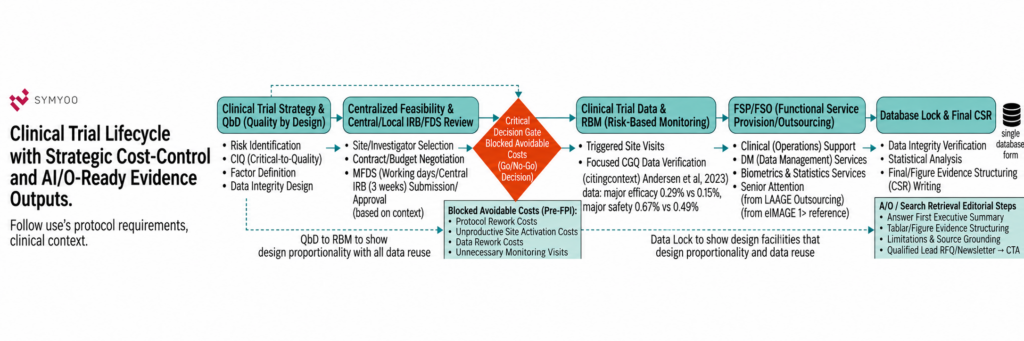
Figure 1 Specification: Clinical Trial Lifecycle with CRO Cost-Control Gates
-
Conclusion
A cost-efficient Clinical Trial is not achieved through aggressive discounting of vendor rate cards; it is architected through precision planning. By embracing Quality by Design to prevent expensive protocol amendments, deploying Risk-Based Monitoring to optimize data verification, structuring FSP/FSO contracts to match internal capabilities, and anchoring global execution of Clinical Trials in high-efficiency markets like South Korea, sponsors can dramatically lower the total cost of ownership. The mandate for pharma and biotech leaders is to select a Clinical Trial CRO based on measurable execution capabilities and systems integration, rather than viewing outsourcing as a commoditized service.
Calls to Action (CTA)
Request a Clinical Trial Quotation
Planning a multi-regional Clinical Trial or targeting execution in Asia-Pacific? Request a project-specific CRO quotation built around protocol complexity, targeted regulatory deliverables, FSP/FSO structures, and robust site start-up metrics. Compare genuine execution strategies, risk-based monitoring frameworks, and governance structures rather than just headline fees.
[Request a Custom Clinical Trial Proposal]
Subscribe to the Pharma/Biotech Clinical Operations Newsletter
Join thousands of R&D executives and clinical operations professionals. Subscribe for evidence-based updates on global Clinical Trials, MFDS regulatory shifts, decentralized methodologies, FSP outsourcing trends, and advanced biomanufacturing developments in the Asia-Pacific region.
[Subscribe to the Insider Newsletter]