
Introduction to the Modern Clinical Trial Landscape
The traditional randomized Clinical Trial remains the undisputed gold standard for establishing evidence of causality and evaluating the efficacy of novel therapeutic interventions. By design, a conventional Clinical Trial carefully controls for confounding factors and minimizes selection bias through strict randomization protocols. However, despite their scientific rigor, traditional Clinical Trials are frequently constrained by highly restrictive eligibility criteria. These stringent parameters often exclude significant portions of the real-world patient population, thereby limiting the external validity and broad clinical applicability of the generated findings. Furthermore, executing a traditional Clinical Trial requires extraordinary financial resources, extended timelines, and immense administrative burdens, making it difficult to answer every pressing medical question.
Conversely, prospective observational cohort studies utilizing patient registries offer broad inclusivity, reflecting real-world clinical practice by enrolling “all-comers.” While these observational studies capture high volumes of long-term outcome data at a fraction of the cost of a typical Clinical Trial, they lack the randomization necessary to adequately control for unknown confounders, often leaving the results vulnerable to bias and limiting robust causal inference.
To resolve this methodological dichotomy, the global pharmaceutical and biotechnology industry is witnessing a paradigm shift toward the Registry-based Randomized Clinical Trial (RRCT). This innovative Clinical Trial methodology integrates the scientific stringency of randomization with the pragmatic, real-world applicability of existing disease registries and electronic medical records (EMRs). By utilizing an established data infrastructure for patient identification, randomization, and follow-up, the registry-based Clinical Trial substantially reduces costs while enhancing the generalizability of the evidence generated. For pharmaceutical professionals, mastering this new Clinical Trial framework is no longer optional; it is imperative for the future of drug and device development.
Anatomy of RRCTs: Clinical Evidence from the TASTE Trial
The viability and profound impact of the RRCT design were definitively proven by the Thrombus Aspiration in ST-Elevation Myocardial Infarction in Scandinavia (TASTE) Clinical Trial. Designed to evaluate the efficacy of thrombus aspiration prior to percutaneous coronary intervention (PCI) versus PCI alone, the TASTE Clinical Trial pioneered the RRCT model by nesting itself entirely within the SWEDEHEART registry.
In this landmark Clinical Trial, the SWEDEHEART registry served multiple core functions that would typically require bespoke, expensive systems in a traditional Clinical Trial. The registry identified eligible patients, embedded an online randomization module, collected baseline procedural characteristics, and seamlessly tracked clinical endpoints such as all-cause mortality and rehospitalization. Because the data infrastructure already existed, the TASTE Clinical Trial enrolled 7,244 patients across 31 Scandinavian centers rapidly, ultimately demonstrating no significant difference in 30-day or 1-year mortality between the treatment arms.
The operational success of the TASTE Clinical Trial highlighted critical advantages over conventional Clinical Trials. It achieved near-complete patient follow-up and demonstrated cost reductions estimated at up to 90% compared to a classical Clinical Trial. Subsequent analyses have indicated that an RRCT can drive down the cost per patient significantly, with some estimates placing the incremental cost of conducting a registry-based Clinical Trial at roughly $430 per patient—a fraction of the tens of thousands typically spent in traditional Clinical Trials.
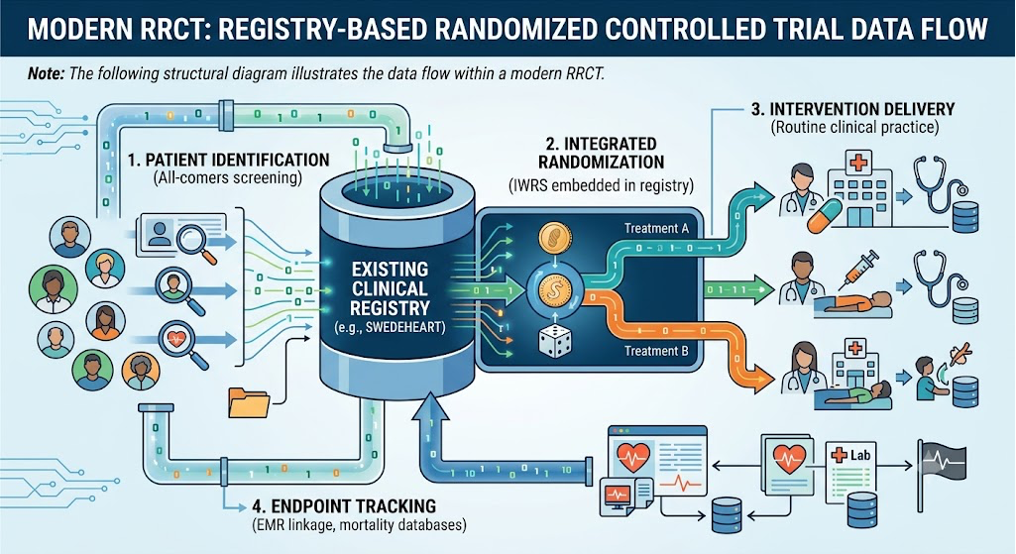
Figure 1: Conceptual Architecture of a Registry-Based Randomized Clinical Trial (RRCT)
|
Feature |
Traditional Clinical Trial |
Registry-Based Randomized Clinical Trial (RRCT) |
|
Patient Population |
Highly selected, restricted eligibility |
Broad, “all-comers”, real-world representation |
|
Data Infrastructure |
Custom electronic Case Report Forms (eCRF) |
Existing national/disease registries (e.g., SWEDEHEART) |
|
Cost & Time |
Exceptionally high cost, prolonged timelines |
Highly cost-effective (up to 90% reduction), rapid enrollment |
|
External Validity |
Often limited due to controlled environment |
High, directly reflects routine clinical practice |
|
Data Quality Challenges |
High precision, extensive source verification |
Dependent on registry quality, requires complex data mapping |
Table 1: Methodological and operational comparison between a traditional Clinical Trial and an RRCT.
Navigating the Regulatory Landscape: EMA, FDA, and ICH E6(R3)
While the scientific community has enthusiastically embraced the RRCT model, regulatory agencies maintain a cautious, highly structured approach to integrating such data for new drug or device approvals. Transitioning a registry from a purely observational tool to the foundational platform for a pivotal Clinical Trial introduces complex data governance challenges that must be meticulously managed.
The European Medicines Agency (EMA) explicitly addressed these methodological considerations in its comprehensive “Guideline on registry-based studies.” The EMA guideline acknowledges that a registry-based Clinical Trial is a powerful tool for monitoring safety and effectiveness, yet it notes that significant questions remain regarding data uniformity, completeness, and regulatory relevance. For any sponsor considering an RRCT as a pivotal Clinical Trial for marketing authorization, the EMA strongly recommends seeking early Scientific Advice from the EMA, National Competent Authorities (NCAs), and Health Technology Assessment (HTA) bodies. The critical regulatory focus for an RRCT is data reliability. Regulators require assurance that the registry captures key variables with an accuracy and traceability that rivals a traditional Clinical Trial.
Similarly, the U.S. Food and Drug Administration (FDA) has advanced its acceptance of real-world evidence through initiatives like Project Pragmatica. Launched by the FDA Oncology Center of Excellence, Project Pragmatica seeks to introduce functional efficiencies by integrating aspects of a Clinical Trial with real-world routine clinical practice. This initiative emphasizes that a pragmatic Clinical Trial can reduce the burden of participation and facilitate more diverse trial populations without sacrificing data integrity.
Concurrently, the regulatory framework governing every Clinical Trial globally is evolving through the International Council for Harmonisation’s updated Good Clinical Practice guideline, ICH E6(R3). This modernized guideline marks a stark departure from rigid, paper-based compliance, embracing the digital Clinical Trial, pragmatic elements, and Real-World Data (RWD). ICH E6(R3) mandates Risk-Based Quality Management (RBQM) for any Clinical Trial, requiring sponsors to focus on “Critical to Quality” factors. For an RRCT, this means the Clinical Trial sponsor must validate the computerized systems governing the registry, ensure audit trails are intact, and guarantee that the data flow from electronic health records into the Clinical Trial database complies with ALCOA+ principles (Attributable, Legible, Contemporaneous, Original, Accurate). By explicitly supporting decentralized trial models and hybrid data sourcing, ICH E6(R3) establishes the legal and ethical foundation necessary for the widespread adoption of the RRCT Clinical Trial format.
Operational Excellence in RRCTs: The SYMYOO Advantage
The operational complexity of conducting an RRCT requires Clinical Trial management organizations to possess specialized, hybrid technological capabilities. Standard data management approaches used in a traditional Clinical Trial are fundamentally insufficient when attempting to integrate vast, unstructured real-world registry databases.
SYMYOO, a premier full-service Contract Research Organization (CRO) based in South Korea, has emerged as a pioneer in optimizing the digital infrastructure required for complex Clinical Trials, particularly the RRCT model. Operating at the bleeding edge of clinical research and digital healthcare technology, SYMYOO has developed robust methodologies to harmonize electronic Case Report Forms (eCRF) with massive registry databases, ensuring seamless data integration and strict regulatory compliance throughout the Clinical Trial lifecycle.
Executing Large-Scale Clinical Trials
SYMYOO’s capacity to manage sophisticated, large-scale Clinical Trials is demonstrated by its role as the designated CRO for several high-profile RRCTs. Notably, SYMYOO acts as the National Coordination Center for the REMATCH study, a massive registry-based randomized Clinical Trial sponsored by the Korea Diabetes Association (KDA). This Clinical Trial aims to define optimal management strategies for type 2 diabetes to improve cardiovascular and renal outcomes, targeting an enrollment of approximately 5,800 patients across more than 60 clinical sites. Managing a Clinical Trial of this scale via traditional methods would be financially prohibitive; the RRCT model makes it feasible.
Furthermore, SYMYOO was selected to manage the iTARGET-Elderly Study, another large-scale RRCT evaluating individualized statin therapies for cardiovascular prevention in elderly diabetic patients. Conducting a Clinical Trial of this magnitude requires extreme precision in patient tracking, data standardization, and safety monitoring across disparate clinical environments. SYMYOO’s historical expertise is not limited to domestic registries; they have served as the global coordinating center for late-phase multinational COVID-19 Clinical Trials and acted as the coordinating center for the landmark ATACH 2 Clinical Trial (an NIH/NINDS phase III study).
Digital Infrastructure: SYNeRA CTMS and Adaptive IWRS
To meet the stringent data governance requirements of ICH E6(R3) during an RRCT, SYMYOO recently launched Phase 1 of its proprietary SYNeRA™ Clinical Trial Management System (CTMS). This next-generation platform integrates advanced IT solutions directly into the Clinical Trial workflow, facilitating the innovative “Man-Unmanned Teaming Clinical Trial (MUM-T CT)” model, which automates routine data capture while reserving human oversight for critical safety parameters.
A successful RRCT also requires a highly agile Interactive Web Response System (IWRS). SYMYOO’s advanced IWRS supports adaptive randomization directly within the registry framework, a critical feature for any pragmatic Clinical Trial. Coupled with electronic diaries (ePRO) and electronic informed consent (eConsent), SYMYOO ensures that the modern Clinical Trial remains highly patient-centric while delivering the cost-effectiveness and scientific rigor demanded by today’s pharmaceutical researchers.
Conclusion
The global Clinical Trial ecosystem is undergoing a permanent, technology-driven transformation. The registry-based randomized Clinical Trial represents the optimal synthesis of scientific validity and real-world applicability. By leveraging existing health data infrastructures, an RRCT dramatically reduces the financial burden of clinical research while providing evidence that truly reflects diverse patient populations. However, successfully executing this innovative Clinical Trial model demands profound expertise in regulatory guidelines (such as EMA stipulations and ICH E6(R3)) and highly advanced digital data integration. Organizations like SYMYOO are at the forefront of this evolution, providing the specialized technological frameworks and Clinical Trial management systems necessary to generate high-quality clinical evidence efficiently. As the pharmaceutical industry continues to seek cost-effective, highly generalizable data, the RRCT will undoubtedly become a cornerstone of future Clinical Trial designs.
Elevate Your Next Clinical Trial with SYMYOO
Are you planning your next innovative Clinical Trial or seeking to leverage real-world data for an upcoming RRCT? Partner with a CRO that understands the intersection of regulatory rigor and digital agility.
Request a Quote: Contact our business development team today to discuss tailored operational strategies for your upcoming Clinical Trial.
Subscribe to our Newsletter: Stay ahead of Clinical Trial trends, ICH E6(R3) updates, and digital healthcare innovations by subscribing to the SYMYOO Insights Newsletter.